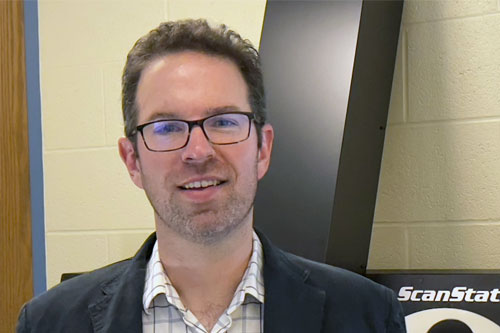
Biography
Current and Future Projects
- Book project about the history of the TV movie THE DAY AFTER
- Data mining Hollywood pressbooks and early TV GUIDE
- Enhancing, diversifying, and extending the collections of the Media History Digital Library and Wisconsin Center for Film and Theater Research.
Expertise and Activities
I am the Kahl Family Professor of Media Production and a Professor of Film, Media and Cultural Studies in the Department of Communication Arts at the University of Wisconsin–Madison.
My teaching and research concentrate on digital media production, the digital humanities, media industries, and the histories of American film and broadcasting.
I am the Director of the Wisconsin Center for Film and Theater Research and Media History Digital Library, which has digitized over 3 million pages of historic books and magazines for broad public access. I also served as the lead developer of Lantern, the MHDL’s search platform, and Arclight, a data analytics and visualization app for the MHDL’s collection.
My first book Hollywood Vault: Film Libraries before Home Video (University of California Press, 2014) explores the history of how old movies became valuable. I also co-edited the books Hollywood and the Law (BFI/Palgrave, 2015), The Arclight Guidebook to Media History and the Digital Humanities (REFRAME, 2016), and Saving New Sounds: Podcast Preservation and Historiography (University of Michigan Press, 2021).
My most recent book, Ink-Stained Hollywood: The Triumph of American Cinema’s Trade Press, was published in March 2022 by the University of California Press as part of its open access Luminos program. The book is a history of the trade papers that chronicled the early years of Hollywood and spoke to competing factions within the industry.
My new book project is a history of the landmark 1983 TV movie, The Day After(1983).
Education
- Ph.D. Division of Critical Studies, School of Cinematic Arts, University of Southern California, 2012
- M.F.A. Peter Stark Producing Program, School of Cinematic Arts, University of Southern California, 2008
- B.S. Radio-TV-Film, School of Communication, Northwestern University, 2005.
Books
2022. Eric Hoyt, Ink-Stained Hollywood: The Triumph of American Cinema’s Trade Press (Berkeley: University of California Press, 2022).
2021. Jeremy Wade Morris and Eric Hoyt, eds., Saving New Sounds: Dispatches from the PodcastRE Project (Ann Arbor: University of Michigan Press, 2021).
2016. Charles R. Acland and Eric Hoyt, eds., The Arclight Guidebook to Media History and the Digital Humanities (Falmer: REFRAME/Project Arclight, 2016). Open access PDF and EPUB downloadable at http://projectarclight.org/book.
2015. Paul McDonald, Emily Carman, Eric Hoyt, and Philip Drake, eds., Hollywood and the Law (London: BFI/Palgrave, 2015).
2014. Eric Hoyt, Hollywood Vault: Film Libraries before Home Video (Berkeley: University of California Press, 2014).
Honors/Awards
- Digital Humanities Advancement Grant. Amount: $294,265. Role: Co-PI. Partner: Stephanie Sapienza (PI) at the Maryland Institute of Technology. Duration: 2021—2023. Awarded for “Broadcasting Audiovisual Data: Using Linked Data and Local Authority Aggregators to Enhance Discoverability for Broadcasting.”
- ACLS Digital Extension Grant. Amount: $150,0000. Role: PI. Partner: Kelley Conway (Co-PI). Duration: 2019—2021. Awarded for “Enhancing and Globalizing the Media History Digital Library.”
- NEH Humanities Collections and Reference Resources Grant. Amount: $217,000. Role: Co-PI. Partner: Stephanie Sapienza (PI) at the Maryland Institute of Technology. Duration: 2018—2020. Awarded for Unlocking the Airwaves: Revitalizing an Early Public and Educational Radio Collection.
- NEH Digital Humanities Advancement Grant. Amount: $74,972. Role: Co-PI. Partner: Jeremy Morris (PI) at the University of Wisconsin–Madison. Duration: 2017—2019. Awarded for PodcastRE Analytics: Investigating the Golden Age of Podcasting through Metadata and Sound.
- Mary Pickford Foundation Grant. Amount: $5,000. Role: PI. Duration: 2019—2020. Awarded for Media History Digital Library open access scanning of press books.
- University of California – California Digital Library Grant. Amount: $10,000. Role: PI. Duration: 2019—2020. Awarded for the Media History Digital Library’s open access scanning of TV Guide from the collection of the Prelinger Library.
- University of Toronto Digitization Grant. Amount: $5,000. Role: PI. Duration: 2018—2019. Awarded for the Media History Digital Library’s open access scanning of Hollywood Studio Magazine.
- Best Use of DH for Fun, Digital Humanities Awards, 2018. Awarded for PodcastRE.
- Mary Pickford Foundation Grant. Amount: $10,000. Role: PI. Duration: 2017—2018. Awarded for Media History Digital Library Website Redesign.
- Digging into Data Grant. Amount: $200,000. Role: PI of US Research Team. Sponsors: IMLS, and SSHRC. Partner: Charles Acland (PI of Canadian Research Team), Concordia University. Duration: 2014—2016. Awarded for Project Arclight: Analytics for the Study of 20th Century Media.
- Finalist for the Richard Wall Memorial Award (given for an exemplary work in the field of recorded performance), Theatre Library Association, 2015. Awarded for Hollywood Vault: Film Libraries before Home Video.
- Anne Friedberg Innovative Scholarship Award, Society for Cinema and Media Studies, 2014. Awarded for Lantern. The first time ever the award went to a digital project instead of a book.
- Best Website for Teaching & Learning, American Association of School Librarians, 2014. Awarded for the Media History Digital Library.
- Best Electronic Reference Site, Popular Culture Association and American Culture Association, 2014. Awarded for Lantern.
- Michael Nelson Prize for a Work in Media and History, International Association for Media and History, 2013. Awarded for the Media History Digital Library.
- Best Electronic Reference Site, Popular Culture Association and American Culture Association, 2012. Awarded for the Media History Digital Library.
- Student Writing Award, Society for Cinema and Media Studies, 2009. Awarded for the essay “Writer in the Hole: Desny v. Wilder, Copyright Law, and the Battle Over Ideas.”
Articles
- Eric Hoyt, Mary Huelsbeck, Amanda Smith, Lesley Stevenson, and Lauren Wilks, “Love, Links, Archives: Saving and Sharing the Wendy Clarke Tape Collection,” The Moving Image, accepted and forthcoming in 2022.
- Stephanie Sapienza, Eric Hoyt, Edward Summers, Matt St John, and JJ Bersch, “Healing the Gap: Digital Humanities Methods for the Virtual Reunification of Split Media and Paper Collections,” Digital Humanities Quarterly 15, no. 1 (2021): http://www.digitalhumanities.org/dhq/vol/15/1/000509/000509.html.
- Eric Hoyt, JJ Bersch, Susan Noh, Samuel Hansen, Jacob Mertens, and Jeremy Wade Morris, “PodcastRE Analytics: Using RSS to Study the Cultures and Norms of Podcasting,” Digital Humanities Quarterly 15, no. 1 (2021): http://www.digitalhumanities.org/dhq/vol/15/1/000519/000519.html.
- Jeremy Wade Morris, Samuel Hansen, and Eric Hoyt, “The PodcastRE Project: Curating and Preserving Podcasts (and Their Data),” Journal of Radio and Audio Media 26, no. 1 (2019): 8—20. DOI: 10.1080/19376529.2019.1559550.
- Derek Long, Eric Hoyt, Anthony Tran, Kevin Ponto, and Kit Hughes, “Who’s Trending in 1910s American Cinema?: Exploring ECHO and MHDL at Scale with Arclight,” The Moving Image 16, no. 1 (2016): 57—81.
- Eric Hoyt, Derek Long, Anthony Tran, and Kit Hughes, “Variety’s Transformations: Digitizing and Analyzing a Canonical Trade Paper,” Film History 27, no. 4 (2015): 76—105.
- Kit Hughes, Eric Hoyt, Derek Long, Kevin Ponto, and Anthony Tran, “Hacking Radio History’s Data: Station Call Letter, Digitized Magazines, and Scaled Entity Search,” Media Industries Journal 2, no. 2 (2015): n.p. http://www.mediaindustriesjournal.org/index.php/mij/article/view/128/182.
- 2015. “Distribution’s Return Trip: Two Hollywood Studios, Money, and Japan, 1921—1941.” Velvet Light Trap, 75 (Spring 2015): 5—20, http://muse.jhu.edu/journals/the_velvet_light_trap/v075/75.hoyt.html.
- 2014. “Lenses for Lantern: Data Mining, Visualization, and Excavating Film History’s Neglected Sources.” Film History, 26, no. 2 (Summer 2014): 146—168, http://www.jstor.org/stable/10.2979/filmhistory.26.2.146.
- 2014. “The Thieves of Bombay: Douglas Fairbanks, Colonial Copyright, and Film Piracy in India, 1927-1935 (Co-authored with Nitin Govil).” Bioscope: South Asian Screen Studies, 5, no. 1 (2014): 5—27, http://bio.sagepub.com/content/5/1/5.full.pdf.
- 2014. “Visualizing and Analyzing the Hollywood Screenplay with ScripThreads (Co-authored with Kevin Ponto and Carrie Roy).” Digital Humanities Quarterly, 8, no. 4, http://www.digitalhumanities.org/dhq/vol/8/4/000190/000190.html.
- 2014. “Scaled Entity Search: A Method for Media Historiography and Response to Critiques of Big Humanities Data Research (Co-authored with Kit Hughes, Derek Long, Kevin Ponto, and Anthony Tran).” Proceedings of IEEE Big Humanities Data, https://bighumanities.files.wordpress.com/2014/10/hoyt.pdf.
- 2013. “Bootstrapping a Digital Archive? 5 Things to Consider.” The Spectator, 33, no. 2, 31-37.
- 2013. “Media + History + Digital + Library: An Experiment in Synthesis (Co-authored with Carl Hagenmaier and Wendy Hagenmaier).” Journal of E-Media Studies, 3, no. 1, https://commarts.wisc.edu/10.1349/PS1.1938-6060.A.430.
- 2011. “Writer in the Hole: Desny v. Wilder, Copyright Law, and the Battle Over Ideas.” Cinema Journal, 50, no. 2, 21-40.
- 2011. “Engaging the Public Domain.” International Journal of Learning and Media, 3, no. 1, 47-55.
- 2010. “Hollywood and the Income Tax, 1929—1955.” Film History, 22, no. 1, 5-20.
- 2010. “The Future of Selling the Past: Studio Libraries in the 21st Century.” Jump Cut, 50, http://www.ejumpcut.org/archive/jc52.2010/hoytStudioLibraries/.
Courses
CA 155 – Introduction to Digital Media Production
CA 450: Cultural History of American Broadcasting
CA 468: Producing for Internet TV and Video
CA 556: American Film Industry in the Era of the Studio System
CA 557: Contemporary Media Industries
CA 609: Digital Media Production for Graduate Students