Jodi Schneider, combating misinformation at its source, joins iSchool faculty as associate professor
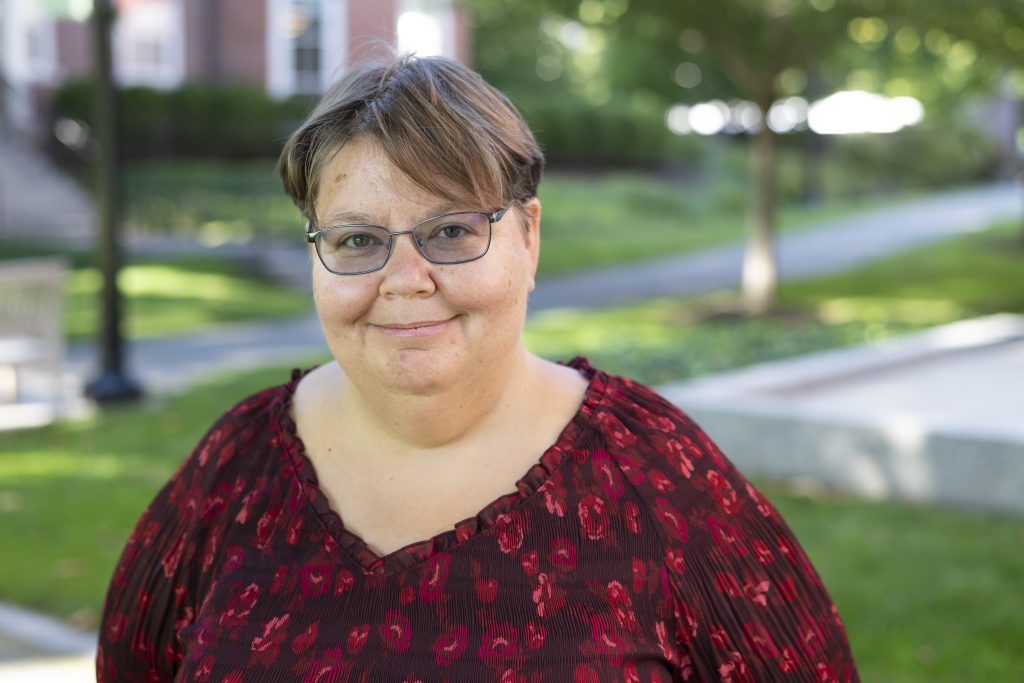
Jodi Schneider has joined the Information School as an associate professor, bringing a unique and wide-ranging research expertise—focused on the science of science and scientific controversies—to UW–Madison as the iSchool’s faculty continues to expand.
Schneider’s research explores information quality, with the ultimate goal of ensuring public policy is informed by the best available scientific evidence. Recently, she has studied how unreliable research lingers in science, often through accidental citations to retracted research—a largely overlooked problem that ripples through future studies and can even affect public policy.
As she begins her tenure in Madison, Schneider is excited to join the Information School’s growing faculty. With a firm academic grounding in the humanities, Schneider understands that the thorniest problems rarely have exclusively scientific solutions. “We can’t approach big problems from an ‘either-or’ perspective, with either technical or humanistic approaches—it has to be both,” she said.
Schneider’s arrival underscores the iSchool’s priority of advancing research that brings information and data together with ethics and human values. Her focus on the integrity of scientific information complements the School’s strengths in information ethics, data science, and human-centered computing, advancing the iSchool’s mission to make information work for people and society.
A broad foundation for complex questions
Schneider’s path in higher education began at St. John’s College in Maryland, where she studied primarily in discussion-based seminars, earning a bachelor’s in Great Books of the Western Tradition. At the time, “I didn’t want to have to choose a major, because I liked science and technology and I liked languages and literature,” she said. That interdisciplinary liberal arts education introduced her to questions she continues to ask today around what makes information credible and trustworthy.
Her career since then has ranged from web librarianship to doctoral work in Ireland on online argumentation to, most recently, an 8-year stint on the faculty of the School of Information Sciences at the University of Illinois at Urbana-Champaign.
The questions that I ask are fundamentally about evidence—how it’s used, and how decisions are made around it.
The problem of retractions
When researchers cite prior studies, they assume those papers represent reliable evidence. But Schneider has found that isn’t always the case. Her research shows that 95% of citations to retracted papers are inadvertent—scientists often don’t realize the work they’re building on has been discredited.
“I’ve had this mission to stop people inadvertently citing retracted papers,” Schneider said, because it can create real problems. For instance, one of Schneider’s papers discusses a falsified clinical trial, studying the relationship between omega-3 fatty acids and inflammation, that continued to be cited by researchers in the years following its retraction. Such citations can lend undue credibility to fully discredited research, allowing misinformation to persist in scientific and public discussions—much like the infamous, long-retracted Wakefield study linking MMR vaccines to autism.
The scale of the retraction problem has grown: more than 10,000 papers were retracted in 2023 alone, Schneider said. Yet systems that track retractions remain inconsistent. “Unfortunately, if you go to different databases, you will get different answers about what exactly is retracted,” she said. To address these issues, Schneider has worked with the National Information Standards Organization (NISO) to influence international publishing processes. For instance, the Committee on Publication Ethics recently cited her group’s recommendations in its updated guidelines, influencing best practices in scientific publishing for years to come. She is also working with a committee on corrections and retractions for the National Academies of Sciences, Engineering, and Medicine.
Beyond retractions, Schneider’s research also explores how humans and machines create and process information. She has examined the “social semantic web,” where online discussion and structured data overlap. In this area, she is working with PhD students to build knowledge graphs that organize climate change evidence and to analyze how empathy shows up in online arguments. In this research, leveraging the latest tools in computing and data science is crucial for making sense of large, text-based datasets.
Why Madison
Schneider said she was drawn to UW–Madison by the iSchool’s unusual mix of humanistic and technical expertise. “This department is really unique,” she noted. “Three philosophers are on the faculty alongside computer scientists and information scholars. That combination matters for questions about how to make systems that work for people at scale.” In addition, she sees the School of Computer, Data & Information Sciences (CDIS) as a fertile environment for collaboration. During her first week in Morgridge Hall, she recalled striking up a conversation with a computer scientist on data management that could lead to future projects. “The building is clearly designed for intersection and collaboration,” she said.
Schneider is already enjoying the wider Wisconsin environment as well, both professionally and personally. The campus offers connections across fields like health sciences, science communication, and science and technology studies—areas she considers vital for making research useful to society. Finally, Schneider said she appreciates Madison’s natural beauty: “There is water all over this town,” she said. “Whether I’m biking or on the bus, I look up and see a sliver of lake. It’s inspiring.”